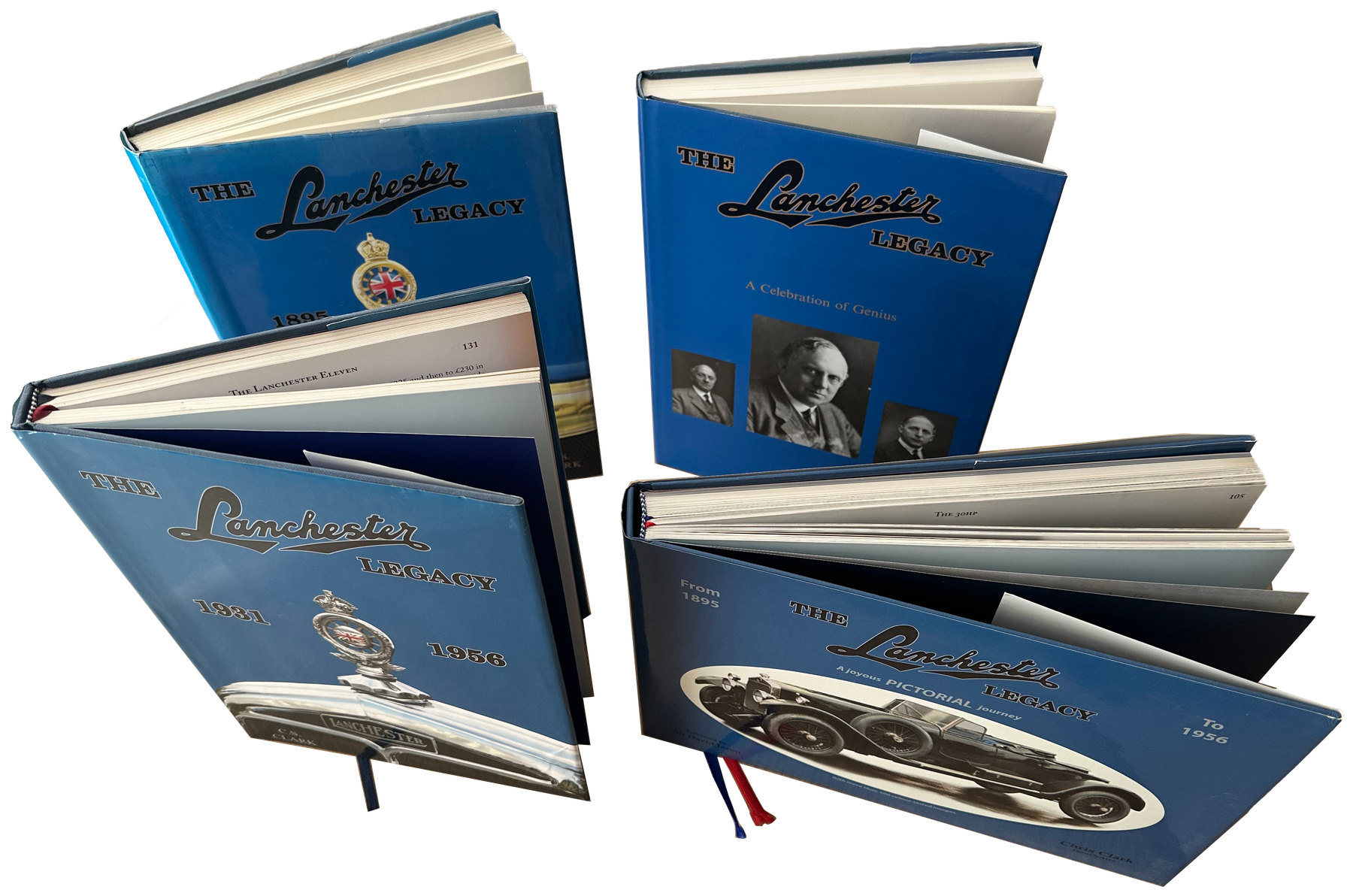
Lanchester Legacy Volume One
1895–1931
This A4-size, 285-page story tells of the Lanchester brothers’ determination to produce top quality, technically correct cars, regardless of convention. Their first was regularly test-driven in 1895, thus becoming the first all-British four-wheel motor car.
The antics of Fred, Frank and George Lanchester are a joy to read, but at the time were a necessary respite from continuous pioneering invention. Their famous cars claimed a loyal following through the veteran years into the 1920s and were heralded as “Pre-eminent among the world’s finest cars.”
Lanchester cars were acclaimed by many, but the company was continually stifled by under-investment. It was sadly destined to be sold in 1931 during the world economic recession.
Reviews of Volume One
Daimler & Lanchester Owners’ Club
Author Chris Clark is well known in the DLOC and is the complete Lanchester enthusiast, restoring and owning dozens of Lanchester cars. He has spent many decades researching all things Lanchester and, as an engineer, he is best qualified to assess the brothers’ achievements, which are very great indeed.
While every page has obviously been written as a labour of love, the work is scholarly, accurate, critical, well written — and above all — readable. Indeed, a reader without a technical background is able to readily appreciate the subject matter.
The book should be compulsory reading for all. It deserves to succeed. There is only one criticism, but this works in the favour of members: this book is grossly underpriced! Very highly recommended.
Rolls-Royce Enthusiasts’ Club
Written by the official Historian of The Lanchester Register, this work marks the centenary of one of the most famous names in motor car design. The Lanchester brothers were men of extraordinary technical ability. They were pioneers in the purest sense, whose ideas were in advance of their time and only gradually understood and adopted by other manufacturers and the public.
Basic principles such as the use of fine threads, vibration control, turbo charging, four-wheel drive, fuel injection, power steering and many others attributable to the Lanchesters are described in this excellent work.
We are reminded that the Lanchester was not only the first all-British four-wheel petrol car, but the only car to have been designed from first principles, ignoring the horseless-carriage mentality completely. It also provided stiff opposition to Rolls-Royce as a contender for the title “best car in the world”, especially with the 40 hp model.
The author deals with the technical, social and financial aspects of the story in a most compelling way. This is without doubt the best and most comprehensive work on Lanchester.
Veteran Car Club
Chris Clark, enthusiastic owner of a number of vintage and veteran Lanchesters, has spent decades investigating the subject. The depth and scope of his research is reflected in comprehensive chapters on the experimental years, the variety of cars made, Lanchesters that raced, the armoured cars of both the Great War and later, and the man behind it all: Dr Frederick Lanchester.
This skilful weaving together of such information is written about with understanding, yet hagiography is avoided. Thus, with this essential human perspective, The Lanchester Legacy is not only informative but is a good read as well.
This reviewer consumed the 100,000 words and came away well satisfied. For a work of such comprehensiveness and quality it is an absolute bargain. Club members should without hesitation treat themselves to a copy.